ESFJ vs ESTJ
Myers-Briggs’ personality types with Thinking (T) and Feeling (F) traits are often considered as great matches for romantic relationships but only if they share the other three major personality functions. ESFJ and ESTJ are exactly these kinds of personality types. Therefore, it’s not surprising that they have a great chance of getting along and building a healthy and loving relationship.
Both ESFJ and ESTJ are highly organized and detail-oriented people who tend to focus on their goals. They don’t mind speaking publicly in front of large crowds and even more, being in social situations makes them feel motivated. They hate making decisions impulsively and prefer to plan everything in advance to avoid mistakes and stress.
The main difference between ESFJ vs ESTJ is that ESFJs are warm-hearted, empathetic people who have a deep understanding of other people’s feelings. On the contrary, ESFJs are rational people who never bother thinking about others’ emotions. Is this difference vital for their relationship? Or can ESFJ and ESTJ adapt to each other’s different attitudes? In this article, we will review these two personality types, compare them and see how compatible they can be.

ESFJ – Extraverted | Sensing | Feeling | Judging
If you know a person who’s always ready to help others without expecting anything in return and behaves altruistically, chances are high that this person is an ESFJ. In fact, people with this personality type are nicknamed Caregivers because helping others and satisfying their needs is the main purpose of their lives. They are naturally warm and supportive people who care deeply about other people’s feelings.
ESFJs enjoy interacting with others and finding out what they need. They are outgoing and organized people who are very loyal either to their friends or partners. They completely rely on people who are close to them and believe that nobody wants to hurt other people. However, this kindness badly impacts their career or academic life. Besides, criticism makes them very sensitive and they hate when something changes around them.
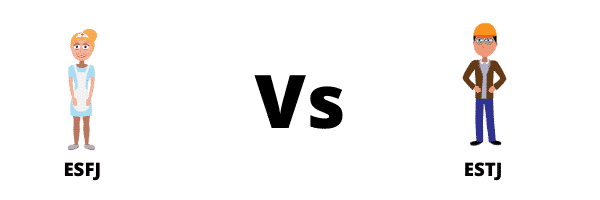
ESTJ – Extraverted | Sensing | Thinking | Judging
ESTJs are indeed the most assertive people from the 16 personality types of MBTI. They are very organized and always behave according to the rules. They believe that following laws and traditions is key to achieving your goals. As a result, they tend to plan everything in advance and make decisions based on logic. ESTJs just can’t adapt to changes even when it’s better to be flexible in some situations. That’s why they are considered rigid and uncompromising people.
The Director is a common nickname for ESTJs. While they may not always be directors, people with this personality actually enjoy managing others and in fact, they are great leaders. The fact that they can’t express feelings and can’t understand others’ emotions is indeed their major weakness. On the contrary, self-assurance and confidence is their strongest characteristic. They are very predictable people but this never stops them from achieving their goals.
The Relationship Between ESFJ & ESTJ – Do They Get Along?
ESFJs and ESTJs are considered some of the best matches for romantic relationships. In fact, ESTJ is most compatible with ESTP and ESTJ, while ESTJs get along perfectly well with ISFPs, INFPs, and ESFJs. The reason is that they have similar attitudes towards many aspects of life. For example, both ESFJs and ESTJs hate impulsive decisions. They believe that spontaneous decisions can damage their careers and planning everything ahead is vital to achieving success.
The only thing that they don’t agree with is their relationship with other people. ESFJs always try to help others and make them feel better but ESTJs believe that everyone should take care of themselves. However, they usually fall in love with each other very easily. Clear communication helps ESFJ and ESTJ couples to balance their relationship and be together for a long time.
ESFJ vs ESTJ: The Main Differences
As we already pointed out, the major difference between ESFJ and ESTJ is that ESFJ possess a Feeling (F) trait, meaning that they are sensitive people and usually express empathy towards others. On the other hand, ESTJs have the Thinking (T) trait which determines their process of decision-making. Let’s discuss the differences between ESFJ vs ESTJ in general values, leadership styles, and romantic relationships.
General Values
- Helping others is the main motivation for ESFJs. They are looking for harmony in every area of life and hate to see somebody in trouble. Taking care of others is their way to try and improve the world a little bit. Although they are very generous and can share their time, energy, and opinions with others, family, and friends and priority for ESFJs.
- ESTJs desire to be competent in everything they do. They value independence and want to be free from other people’s opinions. Besides, they find traditions important and hate when people disobey the rules. That’s especially the case with ESTJ leaders. They always try to get things done and try to be as loyal as possible.
Leadership Styles
- ESFJs don’t like being leaders but on the contrary, people adore ESFJ leaders. The reason is that they always try to help everybody and even if a single member of the team can’t understand something important, they will take time to explain everything. ESFJ leaders usually create a friendly and healthy working atmosphere and as a result, the members of their team easily achieve success.
- Since ESTJs are focused on efficiency, they are very efficient leaders themselves. Even though their team is under pressure most of the time, the result is always positive and it helps them to achieve their goals. As a result, the majority of them like ESTJ leaders and believe that the stress is worth getting such great results. However, sometimes they are overly organized and can even fire an employee for a small mistake.
Relationships
- Deep and stable romantic relationships are an integral part of ESFJ’s life. They are very warm-hearted and romantic people who can fall in love at first sight. As a result of their high emotional intelligence, they can easily understand their partners’ feelings and desires and make sure to meet their needs.
- ESTJs are considered as some of the least romantic people of all personality types. They are practical and believe that relationships are not very important. But of course, it doesn’t mean that they don’t fall in love at all. Actually, they do, and falling in love can change their attitudes towards relationships.
Final Words
To sum it up, we can say that at a first glance ESFJs and ESTJs seem completely different people. By comparing ESFJ vs ESTJ we saw that they are completely different leaders, their values are nothing alike and their attitudes towards love are inconsistent as well. However, people with these two personality types possess three major traits, enough to attract each other, fall in love and have a long-term relationship.